
When shopping for outdoor cover, the price gap between a “party tent” and a “professional marquee” can be staggering. At first glance, they both look like white tents. However, the price difference isn’t just branding—it’s the difference between a structure that handles a light breeze and one that stands firm in a storm.
Here is the breakdown of why you pay more for a marquee and why it’s usually worth it.
1. The Cover Material: Fused vs. Stitched
The most critical difference lies in the “skin” of the structure.
- The Gazebo Standard (PE): Most budget gazebos use Polyethylene (PE), typically weighing 180gsm to 200gsm. PE is a lightweight plastic weave. Because it is a fabric, it must be stitched together. Every stitch creates a needle hole, meaning in heavy rain, a gazebo can never truly be 100% waterproof.
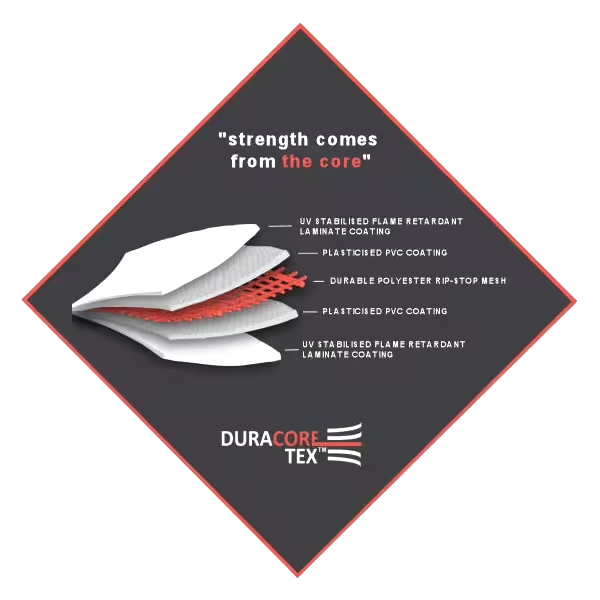
- The Marquee Standard (PVC): Professional marquees use heavy-duty PVC, usually 500gsm or 650gsm.
- RF Welding: Instead of being sewn, PVC panels are Radio Frequency (RF) welded. This process uses radio waves to vibrate the molecules and fuse the material into one continuous piece. This creates a bond that is 100% waterproof.
- Tensile Strength: High-end covers, such as Duracoretex PVC, offer extreme durability. For example, 500gsm Duracoretex has a tensile strength of 1707N, rising to 1843N for 650gsm, ensuring the cover won’t tear under the pressure of wind or pooling water.
2. The Skeleton: Engineering vs. Simplicity
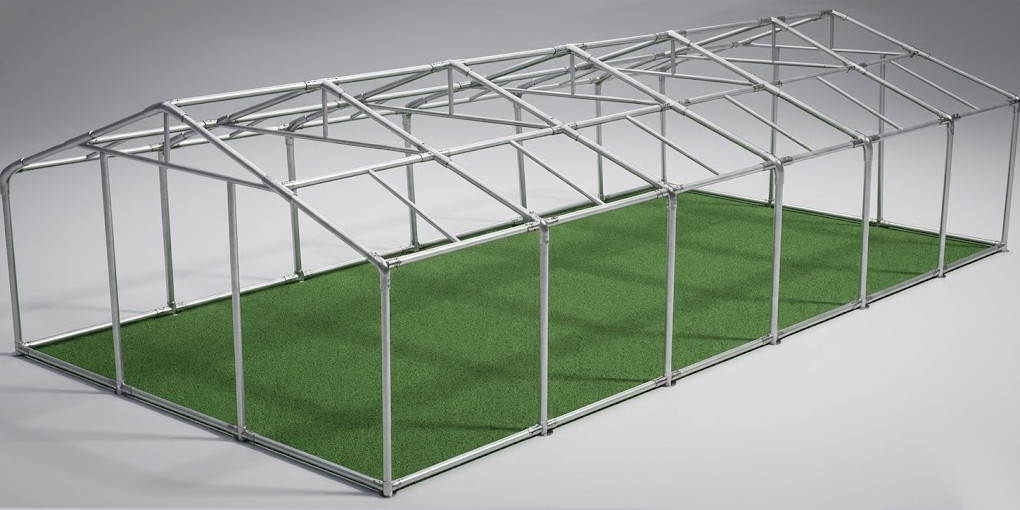
If the fabric is the skin, the frame is the bone structure. A gazebo is designed for “convenience,” while a marquee is designed for “integrity.”
| Feature | Lightweight Gazebo / Party Tent | Professional Marquee |
| Material | Thin steel or plastic joints | Galvanised steel or Aluminium |
| Ground Bars | Usually missing | Included to prevent “leg spread” |
| Roof Braces | Minimal or none | Full bracing to prevent buckling |
| Gable Uprights | Open ends | Reinforced vertical supports at each end |
Without purlins, roof braces, and gable uprights, a gazebo lacks the lateral stability to stay square. In a high wind, a gazebo’s frame often twists and snaps, whereas a marquee’s reinforced framework is designed to distribute that energy safely.
3. Longevity and “Cost Per Use”
While a gazebo is cheaper upfront, it is often a “single-season” product. If it rains hard or the wind picks up, the PE fabric may leak or the frame may fail.
A marquee is a professional asset. Because of the galvanised framework and the high-tensile PVC, these structures are built to be used dozens of times over many years. When you calculate the “cost per use,” the marquee often ends up being the more economical choice for anyone hosting more than one event.
4. Safety and Compliance: Fire Retardancy
When you host an event, you aren’t just responsible for the decor; you are responsible for the people inside. This is where the gap between a “retail tent” and a “professional marquee” becomes a matter of safety.
- The Gazebo Risk: Many entry-level PE gazebos are treated with a basic water-repellent coating but are not inherently fire retardant. In the presence of a patio heater, catering equipment, or a stray spark, lightweight PE can ignite and melt rapidly.
- The Marquee Standard: A professional marquee is built to strictly regulated safety standards. For instance, all DIY Marquees are manufactured to be fire retardant to BS5438 and BS7837.
- Why this matters: These British Standards ensure that the fabric is resistant to ignition. If a flame source comes into contact with the PVC, the material is designed to self-extinguish rather than act as fuel for the fire.
- Commercial Necessity: If you are a commercial hire company, providing a non-fire-retardant structure is a major liability. Most venues and local authorities will require proof of BS5438/BS7837 certification before allowing a structure to be erected on their grounds.
The Verdict: Why the Price Difference Matters
To summarize your main points, the price difference reflects a total upgrade in every component:
- The Fabric: You are moving from thin, stitched PE (200gsm) that leaks at the seams to heavy-duty, RF-welded PVC (500-650gsm) that is 100% waterproof and features high tensile strength (up to 1843N).
- The Frame: You are moving from a simplified “pop-up” skeleton to a galvanised steel or aluminium powerhouse equipped with ground bars, purlins, and gable uprights for structural integrity.
- The Safety: You are investing in peace of mind with fire retardancy (BS5438 & BS7837), ensuring the structure is legal for commercial use and safe for guests.
The Bottom Line: A gazebo is a “fair weather” product. A marquee is a “four-season” solution. If your event depends on the structure staying up and staying dry regardless of the British weather, the investment in a marquee pays for itself the very first time the clouds turn grey.